

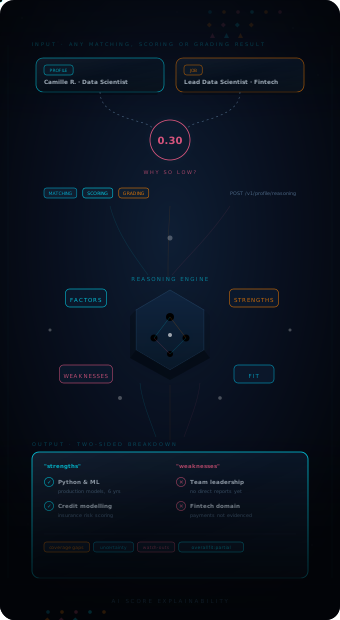
The Reasoning API serves a two-sided large reasoning model (LRM) that explains why the scores produced by the Matching API, Scoring API, and Grading API are high or low for a given profile or job. Powered by Hiring Superintelligence and trained on 1.2B hiring decisions and 400 million career paths, it surpasses human expert judgment, and it delivers audit-ready explanations, upskilling paths, and interview checkpoints to ensure fair, defensible hiring aligned with the EU AI Act.
Trusted by Customers, Partners & the AI Ecosystem






Get fine-grained, structured JSON (Spider Charts) explaining every score. Extract differentiating strengths, coverage gaps, transferable skills, and uncertainty areas to power personalized rejection emails, internal mobility paths, and recruiter coaching.
Differentiating Strengths
Education, Expertise, Technical skills, Soft skills, Impact
Coverage Gaps
Tools, Industry knowledge
Uncertainty Areas
Evidence, Past context
Watch-outs
Career stability, False-negative risk
Items to Confirm in Interview
Motivation, Communication, Environment fit
Growth Potential
Career progression, Adaptability
Upskilling Opportunities
Analytical skills, Leadership
Transferable Skills
Collaboration, Autonomy
Evidence Level
Seniority, Responsibility scope, Work complexity
Overall Alignment with the Job
Professional experience, Execution, Job fit
1{ 2 "code": 200, 3 "message": "SWOT prediction finished in 9.18 seconds.", 4 "data": { 5 "strengths": [ 6 { 7 "description": "The candidate completed a general engineering program at Ecole Centrale Casablanca with an option in data science and digitalization. This meets the requirement for a degree in a related field.", 8 "name": "Bachelor's or Master's degree in Data Science or related field" 9 },10 {11 "description": "The candidate has worked in teams for projects and used Agile Scrum methodology, indicating collaboration with others.",12 "name": "Cross-functional team collaboration"13 },14 {15 "description": "The candidate has created data visualization applications using R and is familiar with Power BI.",16 "name": "Dashboard and data visualization creation"17 },18 {19 "description": "The candidate has experience developing machine learning models for sentiment analysis and detection tasks, as well as relevant coursework and projects.",20 "name": "Data science or machine learning experience"21 },22 {23 "description": "The candidate has used Pandas in machine learning projects. There is no explicit mention of NumPy or Scikit-learn.",24 "name": "Pandas, NumPy, or Scikit-learn experience"25 },26 {27 "description": "The candidate has developed machine learning models for classification and detection tasks.",28 "name": "Predictive modeling and machine learning algorithm development"29 },30 {31 "description": "The candidate lists Python and R as skills and has used them in multiple projects.",32 "name": "Python or R proficiency"33 },34 {35 "description": "The candidate lists SQL as a skill and has experience with Oracle and Informix databases.",36 "name": "SQL and database management knowledge"37 },38 {39 "description": "The candidate is familiar with Power BI, as listed in the skills section.",40 "name": "Tableau or Power BI experience"41 },42 {43 "description": "The candidate has used TensorFlow in machine learning projects for sentiment analysis and classification.",44 "name": "TensorFlow experience"45 }46 ],47 "weaknesses": [48 {49 "description": "The candidate has worked on machine learning projects involving data integration and manipulation, but there is no explicit mention of analyzing large datasets.",50 "name": "Data analysis of large datasets"51 },52 {53 "description": "The candidate completed coursework in data security but there is no explicit evidence of managing data integrity, accuracy, and security in professional projects.",54 "name": "Data integrity, accuracy, and security management"55 }56 ]57 }58}Test the API in real-time with your own data. Get production-ready code in seconds.
Interactive testing environment
 Postman CollectionCollection
Upload a CV to reason
PDF, Word, or Image - Maximum size: 20 MB.
Enter your API token or sign in to try the reasoning demo.
{
  "code": 200,
  "message": "SWOT prediction finished in 9.18 seconds.",
  "data": {
    "strengths": [
      {
        "name": "Data science or machine learning experience",
        "description": "The candidate has experience..."
      }, ...
    ],
    "weaknesses": [
      {
        "name": "Data analysis of large datasets",
        "description": "No explicit mention..."
      }, ...
    ]
  }
}Trusted by fast-growing HR Tech and Global Enterprise
HiredScore helped us understand criteria overlap, but it didn't give us a real reasoning layer for why a candidate should move forward, what was uncertain, or what still needed to be validated by a recruiter.
HrFlow.ai Reasoning gave us real-time, HR-native, audit-ready decision intelligence grounded in labor-market data. It turned opaque match outputs into structured strengths, gaps, uncertainty flags, interview checkpoints, and fairness-ready rationale.
Generic LLM outputs were too unstable, too generic, and too hard to govern for production hiring. JSON drift, hallucinated rationale, and inconsistent terminology made compliance-sensitive workflows risky.
HrFlow.ai Reasoning gave us deterministic, unified, HR-native explanations in real time, with labor-market-grounded reasoning for recruiter review, candidate transparency, and audit preparation.
Phenom gave us criteria-based commentary, but it was still mostly recruiter-side and too limited when we wanted to explain to candidates why a job was worth pursuing.
HrFlow.ai Reasoning added a real candidate-side layer: why the role fit their background, what growth it could unlock, which skills would transfer, and what made the opportunity attractive. That clarity increased engagement and conversion.
HiredScore helped us understand criteria overlap, but it didn't give us a real reasoning layer for why a candidate should move forward, what was uncertain, or what still needed to be validated by a recruiter.
HrFlow.ai Reasoning gave us real-time, HR-native, audit-ready decision intelligence grounded in labor-market data. It turned opaque match outputs into structured strengths, gaps, uncertainty flags, interview checkpoints, and fairness-ready rationale.
Generic LLM outputs were too unstable, too generic, and too hard to govern for production hiring. JSON drift, hallucinated rationale, and inconsistent terminology made compliance-sensitive workflows risky.
HrFlow.ai Reasoning gave us deterministic, unified, HR-native explanations in real time, with labor-market-grounded reasoning for recruiter review, candidate transparency, and audit preparation.
Phenom gave us criteria-based commentary, but it was still mostly recruiter-side and too limited when we wanted to explain to candidates why a job was worth pursuing.
HrFlow.ai Reasoning added a real candidate-side layer: why the role fit their background, what growth it could unlock, which skills would transfer, and what made the opportunity attractive. That clarity increased engagement and conversion.
HiredScore helped us understand criteria overlap, but it didn't give us a real reasoning layer for why a candidate should move forward, what was uncertain, or what still needed to be validated by a recruiter.
HrFlow.ai Reasoning gave us real-time, HR-native, audit-ready decision intelligence grounded in labor-market data. It turned opaque match outputs into structured strengths, gaps, uncertainty flags, interview checkpoints, and fairness-ready rationale.
Generic LLM outputs were too unstable, too generic, and too hard to govern for production hiring. JSON drift, hallucinated rationale, and inconsistent terminology made compliance-sensitive workflows risky.
HrFlow.ai Reasoning gave us deterministic, unified, HR-native explanations in real time, with labor-market-grounded reasoning for recruiter review, candidate transparency, and audit preparation.
Phenom gave us criteria-based commentary, but it was still mostly recruiter-side and too limited when we wanted to explain to candidates why a job was worth pursuing.
HrFlow.ai Reasoning added a real candidate-side layer: why the role fit their background, what growth it could unlock, which skills would transfer, and what made the opportunity attractive. That clarity increased engagement and conversion.
HiredScore helped us understand criteria overlap, but it didn't give us a real reasoning layer for why a candidate should move forward, what was uncertain, or what still needed to be validated by a recruiter.
HrFlow.ai Reasoning gave us real-time, HR-native, audit-ready decision intelligence grounded in labor-market data. It turned opaque match outputs into structured strengths, gaps, uncertainty flags, interview checkpoints, and fairness-ready rationale.
Generic LLM outputs were too unstable, too generic, and too hard to govern for production hiring. JSON drift, hallucinated rationale, and inconsistent terminology made compliance-sensitive workflows risky.
HrFlow.ai Reasoning gave us deterministic, unified, HR-native explanations in real time, with labor-market-grounded reasoning for recruiter review, candidate transparency, and audit preparation.
Phenom gave us criteria-based commentary, but it was still mostly recruiter-side and too limited when we wanted to explain to candidates why a job was worth pursuing.
HrFlow.ai Reasoning added a real candidate-side layer: why the role fit their background, what growth it could unlock, which skills would transfer, and what made the opportunity attractive. That clarity increased engagement and conversion.
TestGorilla was useful for defined workflows, but we needed to evaluate existing profiles instantly for new roles, support internal mobility, and re-engage talent pools without requiring new tests each time.
HrFlow.ai Reasoning generates real-time explanations of fit, gaps, mobility potential, and watch-outs directly from the profile and job. A more flexible decision layer for redeployment, internal mobility, and talent-pool reuse.
We built our own explanation layer with SHAP and LIME, but it never became truly usable for hiring. It explained features, not decisions. It lacked labor-market context, didn't generalize across job families, and wasn't built for multilingual hiring.
HrFlow.ai Reasoning gave us what we were missing: real-time, recruiter-ready, candidate-ready reasoning grounded in actual hiring data.
We built an explanation layer with Elasticsearch highlights and boosting rules, but it was still just keyword overlap dressed up as reasoning. It missed labor-market context, transferable skills, and uncertainty.
HrFlow.ai Reasoning replaced that patchwork with a real-time API that explained why a fit was strong or weak, what was missing, and what needed human verification before making a decision.
TestGorilla was useful for defined workflows, but we needed to evaluate existing profiles instantly for new roles, support internal mobility, and re-engage talent pools without requiring new tests each time.
HrFlow.ai Reasoning generates real-time explanations of fit, gaps, mobility potential, and watch-outs directly from the profile and job. A more flexible decision layer for redeployment, internal mobility, and talent-pool reuse.
We built our own explanation layer with SHAP and LIME, but it never became truly usable for hiring. It explained features, not decisions. It lacked labor-market context, didn't generalize across job families, and wasn't built for multilingual hiring.
HrFlow.ai Reasoning gave us what we were missing: real-time, recruiter-ready, candidate-ready reasoning grounded in actual hiring data.
We built an explanation layer with Elasticsearch highlights and boosting rules, but it was still just keyword overlap dressed up as reasoning. It missed labor-market context, transferable skills, and uncertainty.
HrFlow.ai Reasoning replaced that patchwork with a real-time API that explained why a fit was strong or weak, what was missing, and what needed human verification before making a decision.
TestGorilla was useful for defined workflows, but we needed to evaluate existing profiles instantly for new roles, support internal mobility, and re-engage talent pools without requiring new tests each time.
HrFlow.ai Reasoning generates real-time explanations of fit, gaps, mobility potential, and watch-outs directly from the profile and job. A more flexible decision layer for redeployment, internal mobility, and talent-pool reuse.
We built our own explanation layer with SHAP and LIME, but it never became truly usable for hiring. It explained features, not decisions. It lacked labor-market context, didn't generalize across job families, and wasn't built for multilingual hiring.
HrFlow.ai Reasoning gave us what we were missing: real-time, recruiter-ready, candidate-ready reasoning grounded in actual hiring data.
We built an explanation layer with Elasticsearch highlights and boosting rules, but it was still just keyword overlap dressed up as reasoning. It missed labor-market context, transferable skills, and uncertainty.
HrFlow.ai Reasoning replaced that patchwork with a real-time API that explained why a fit was strong or weak, what was missing, and what needed human verification before making a decision.
TestGorilla was useful for defined workflows, but we needed to evaluate existing profiles instantly for new roles, support internal mobility, and re-engage talent pools without requiring new tests each time.
HrFlow.ai Reasoning generates real-time explanations of fit, gaps, mobility potential, and watch-outs directly from the profile and job. A more flexible decision layer for redeployment, internal mobility, and talent-pool reuse.
We built our own explanation layer with SHAP and LIME, but it never became truly usable for hiring. It explained features, not decisions. It lacked labor-market context, didn't generalize across job families, and wasn't built for multilingual hiring.
HrFlow.ai Reasoning gave us what we were missing: real-time, recruiter-ready, candidate-ready reasoning grounded in actual hiring data.
We built an explanation layer with Elasticsearch highlights and boosting rules, but it was still just keyword overlap dressed up as reasoning. It missed labor-market context, transferable skills, and uncertainty.
HrFlow.ai Reasoning replaced that patchwork with a real-time API that explained why a fit was strong or weak, what was missing, and what needed human verification before making a decision.
Integrate 200+ tools with the flip of a switch.













HR-native ETL with 200+ connectors plus Webhooks to ingest, normalise, and sync jobs & profiles across your stack—reliable pipelines with unified schemas.

No-code automation platform with 8,000+ app integrations to move data between tools using triggers + actions.

Visual automation platform to extract/transform/route data across 3,000+ apps (plus HTTP modules for any API).

Microsoft Power Automate—workflow automation with 1,000+ API connectors (and support for custom connectors).

Enterprise iPaaS/automation platform with 1,200+ pre-built connectors for orchestrating integrations and data workflows at scale.

Salesforce's low-code workflow automation tool; extended via AppExchange with 7,000+ apps to add integrations and capabilities.
HrFlow.ai Reasoning is an API that turns Matching, Scoring, and Grading outputs into structured hiring intelligence. Grounded in labor-market data and trained on 1.2B hiring and interview outcomes shaped by expert recruiter signals, it explains fit, gaps, uncertainty, interview checkpoints, and upskilling or mobility opportunities. With reasoning in 43+ languages, recruiter and candidate coaching, and audit-ready fairness, it serves as a decision-intelligence and compliance layer that helps teams make hiring decisions that are more transparent, reviewable, and legally defensible across GDPR/UK GDPR, EEOC, NYC AEDT, and EU AI Act contexts.
Built for sensitive HR data—secure by default, enterprise-ready.
TLS in transit + encryption at rest to protect documents and extracted data.
Minimal storage by default, with configurable retention policies to match your compliance needs.
Built for sensitive HR data—secure by default, enterprise-ready. AI Act– and GDPR-ready processing, with documented controls for data handling and compliance.
Data processing and storage can be aligned with your required region (e.g., EU or US) depending on your deployment.
| Feature | |  |  |  |  | XA | GB |  | |||||||||
|---|---|---|---|---|---|---|---|---|---|---|---|---|---|---|---|---|---|
| Deployment & Trust | |||||||||||||||||
| Headquarters | 🇫🇷 France | 🇺🇸 USA | 🇺🇸 USA | 🇳🇱 Netherlands | 🇺🇸 USA | 🇺🇸 USA | 🇺🇸 USA | 🇺🇸 USA | |||||||||
| 🇺🇸 USA & 🇪🇺 EU Servers | Built-in | config | config | Built-in | config | config | config | config | |||||||||
| GDPR / AI-Act readiness | By design | By design | config | ||||||||||||||
| HR Compliance (Safety & Guardrails) | Built-in | (Class Action) | Built-in | Limited | |||||||||||||
| Pretraining Data | 1,2B Hiring Signals (Top Hiring firms) | Noisy Corporate data (Hiring Signals) | Noisy & Biased Web Data | No outcome-based training | Noisy Corporate data (Applicants' Signals) | Requires trainset | Requires trainset | No outcome-based training | |||||||||
| HR-Focused | |||||||||||||||||
| Input Security (Prompt injection) | |||||||||||||||||
| Unified output object (JSON drift) | |||||||||||||||||
| Deterministic output values (hallucination) | (Mood influence) | ||||||||||||||||
| Pricing model | per request | per subscription (bundle) | per input+output tokens (expensive) | per subscription (bundle) | per subscription (bundle) | per Server | per Server | per Server | |||||||||
| Real-time API | Built-in (~2s/request) | Not supported | built-in (~30s/request) | Requires candidates | Requires candidates | Built-in (~100ms/request) | Built-in (~100ms/request) | Built-in (~1s/request) | |||||||||
| UI Access | Built-in | Built-in | Built-in | Built-in | |||||||||||||
| Core Technology | |||||||||||||||||
| Technology | Large Reasoning Model / Fairness & Bias Optimization | LLM / Custom ElasticSearch / XAI Methods | LLM | skills tests, cognitive tests, personality/psychometric tests | LLM / Custom ElasticSearch / LightCast | SHAP / LIME / saliency methods | XGBoost & LightGBM feature importance | Apache Lucene Highlighters / Fast Vector Highlighter | |||||||||
| Multilingual | 43 lang | 5 lang | 40 lang | 12 lang | 8 lang | Config | |||||||||||
| Crosslingual | |||||||||||||||||
| Score Explainability | Concepts Overlap | Criteria Overlap | Concepts Overlap | Criteria Overlap | Criteria Overlap | Features Importance | Features Importance | Keywords Overlap | |||||||||
| White-collar Roles Accuracy | High | Medium | Good | Medium | Medium | Low | Low | Low | |||||||||
| Blue-collar Roles Accuracy | High | Low | Medium | Low | Low | Low | Low | Low | |||||||||
| Junior Roles Accuracy | High | Low | Low | Low | Low | Low | Low | Low | |||||||||
| Senior Roles Accuracy | High | Medium | Good | Medium | Medium | Low | Low | Low | |||||||||
| Candidate Strengths and Gaps | Built-in (Outcome-based) | Limited (criteria-based) | Limited (generic) | Limited (criteria-based) | Limited (criteria-based) | Requires trainset | Requires trainset | Limited (criteria-based) | |||||||||
| Job Attractiveness Reasoning | Built-in (Outcome-based) | Limited (generic) | Limited (criteria-based) | Requires trainset | Requires trainset | Limited (criteria-based) | |||||||||||
| Recruiter AI Trainer | Built-in (Outcome-based) | ||||||||||||||||
| Interview Briefing & Fact-Checking | Built-in (Outcome-based) | Limited (generic) | |||||||||||||||
| Upskilling & Mobility Analysis | Built-in (Outcome-based) | Limited (criteria-based) | Limited (generic) | Limited (criteria-based) | Limited (criteria-based) | ||||||||||||
| Custom Feature Engineering | Built-in (Tags & Metadata) | Built-in (Custom questions) | Concept boosting | Built-in (Custom questions) | Built-in (Custom criteria) | Built-in (Custom criteria) | Keyword boosting | ||||||||||
| Fairness Regularization | Built-in (Constraints) | Requires trainset | Requires trainset | ||||||||||||||
| Data Calibration & Debiasing | Built-in (Pipeline) | Requires trainset | Requires trainset | ||||||||||||||
| HR Stack integrations (add-ons) | |||||||||||||||||
| Resume, CV, Job parsers | Built-in (Parsing API) | Third party | Config | Third party | Third party | ||||||||||||
| HR data enrichment & taxonomies | Built-in (Linking/Tagging/Asking APIs) | Third party | Third party | ||||||||||||||
| Browser Extension | Connector (Data Studio) | ||||||||||||||||
| Jobboards / ATS / HCM / HRIS connectors | 200+ connectors (Data Studio) | Built-in | Built-in | Built-in | |||||||||||||
| Candidate & Recruiter UI | Widgets (App Studio) | Built-in | Built-in | Built-in | |||||||||||||
Everything you need to know about the Reasoning API
Our APIs are designed to complement each other and unlock your data's full potential
Transform HR documents into structured, enriched Talent & Workforce Data — powering every layer of Hiring Intelligence.
API OverviewUnlock Hiring Superintelligence at scale — with transparent, fair, and explainable ranking across every Talent signal.
API Overview
GET STARTED
Start parsing resumes and job postings in minutes with our powerful API.
HrFlow.ai is building safe Hiring SuperIntelligence to help reduce unemployment at global scale. Founded in 2016, we are an API-first AI company building foundation models and agents for the labor market, trained on hundreds of millions of career paths and more than 1.2 billion hiring decisions. With over 100M profiles processed, we believe this capability shouldn't be locked inside a single product. Like critical infrastructure, it belongs to the entire HR ecosystem, and today over 1,000 customers build on our platform, backed by more than $10M from investors including BPI France, Amazon, Google, Microsoft, 115k, and Emerging Venture. We build AI for HR that is high-performing, explainable, and deployable at scale, designed to meet global AI compliance standards from GDPR to the EU AI Act and beyond.
The platform provides a complete and fully integrated suite of HR data processing products based on the analysis of hundreds of millions of career paths worldwide -- such as Parsing API, Tagging API, Embedding API, Searching API, Scoring API, and Upskilling API. It also offers a catalog of +200 connectors to build custom scenarios that can automate any business logic.