

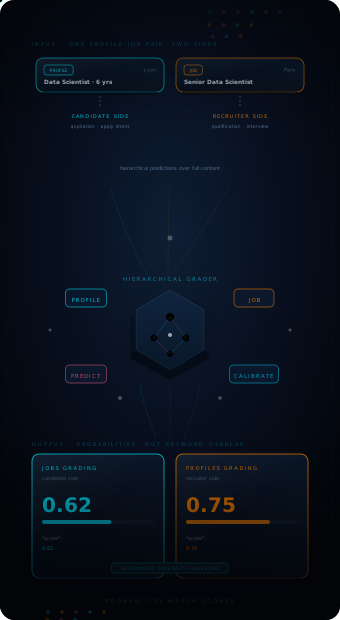
The Grading API serves a two-sided large propensity model (LPM) that predicts a candidate's application intent and interview outcome for a given job. Trained on 1.2 billion hiring interviews and 400 million career paths, it surpasses human expert judgment (achieving 94% accuracy vs 64% for humans) to deliver the ultimate recruiting decision layer, with built-in fairness mitigation and EU AI Act explainability.
Trusted by Customers, Partners & the AI Ecosystem






Get fine-grained evaluation scores for application intent and interview success. Use it to rerank initial Scoring API results, maximize job description engagement, prioritize high-propensity hires, and eliminate low-yield interviews. Results are deterministic: same inputs → same scores.
Send a job + profiles → returns Profiles (JSON) + evaluation Scores.
Anchor Job
key or reference, and board
Grading Algorithm
Recruiter-side: Horus Cosmic, Horus Titan, Horus Turbo, Horus Nano
Profiles
List of profile IDs (key or reference, and source)
 1{
 2  "score": 0.5428632497787476,
 3  "profiles": [
 4    {
 5      "key": "••••••••••••••••••••",
 6      "reference": null,
 7      "source_key": "••••••••••••••••••••",
 8      "archived_at": null,
 9      "updated_at": "2026-06-19T13:31:29+0000",
10      "created_at": "2026-06-19T13:31:26+0000"
11    }
12  ]
13}Pick the right model version for your needs— by use case, speed, precision, and cost.
| Algorithm key | Data | Use Case | Speed | Precision | Languages | ||||||
|---|---|---|---|---|---|---|---|---|---|---|---|
| Horus Cosmic | ProfileJob | Precision model optimized for deep contextual understanding of skills, experience, and cultural alignment. Best suited for accurate, high-stakes ranking in refined talent pools. | 4th | 1st | 43 languages | ||||||
| Horus Titan | ProfileJob | Offers a robust equilibrium between speed and accuracy for reliable ranking performance across diverse candidate profiles. | 3rd | 2nd | 43 languages | ||||||
| Horus Turbo | ProfileJob | Designed for rapid evaluation of large candidate volumes with solid predictive accuracy. Ideal for mass or program-based recruitment. | 2nd | 3rd | 43 languages | ||||||
| Horus Nano | ProfileJob | Ultra-fast, lightweight model built to efficiently identify promising or interview-worthy candidates. | 1st | 4th | 43 languages | ||||||
Automatically grade profiles against a job description, languages, skills, or tasks. Get production-ready code in seconds.
Interactive testing environment
 Postman CollectionCollection
Upload a CV to grade
PDF, Word, or Image - Maximum size: 20 MB.
Enter your API token or sign in to try the grading demo.
{
  "score": 0.5428632497787476,
  "profiles": [
    {
      "key": "••••••",
      "reference": null,
      "source_key": "••••••",
      "archived_at": null,
      "updated_at": "2026-06-19T13:31:29+0000",
      "created_at": "2026-06-19T13:31:26+0000"
    }
  ]
}Trusted by fast-growing HR Tech and Global Enterprise
Completion rates tanked — candidates were dropping off because the testing process was too long, and we were losing qualified people before recruiters could even evaluate them.
HrFlow.ai Grading solved that with ~94% accuracy and ~100ms response time, giving us deterministic recruiter-side and candidate-side scores in real time. We removed friction from the funnel and reduced abandonment.
A clear ChatGPT writing bias meant resumes optimized with OpenAI scored higher regardless of quality. Prompt injection inside resumes became a real production risk.
HrFlow.ai Grading replaced that with a deterministic, HR-native model trained on hiring outcomes. We moved from manipulable keyword wins to stable, secure probability scores.
We couldn’t go back to thousands of passive candidates and ask them to retake long tests just to evaluate them for a new role.
HrFlow.ai Grading grades fit, application likelihood, and hiring likelihood directly from resumes and job descriptions—so we recycle our talent pool without adding friction.
Completion rates tanked — candidates were dropping off because the testing process was too long, and we were losing qualified people before recruiters could even evaluate them.
HrFlow.ai Grading solved that with ~94% accuracy and ~100ms response time, giving us deterministic recruiter-side and candidate-side scores in real time. We removed friction from the funnel and reduced abandonment.
A clear ChatGPT writing bias meant resumes optimized with OpenAI scored higher regardless of quality. Prompt injection inside resumes became a real production risk.
HrFlow.ai Grading replaced that with a deterministic, HR-native model trained on hiring outcomes. We moved from manipulable keyword wins to stable, secure probability scores.
We couldn’t go back to thousands of passive candidates and ask them to retake long tests just to evaluate them for a new role.
HrFlow.ai Grading grades fit, application likelihood, and hiring likelihood directly from resumes and job descriptions—so we recycle our talent pool without adding friction.
Completion rates tanked — candidates were dropping off because the testing process was too long, and we were losing qualified people before recruiters could even evaluate them.
HrFlow.ai Grading solved that with ~94% accuracy and ~100ms response time, giving us deterministic recruiter-side and candidate-side scores in real time. We removed friction from the funnel and reduced abandonment.
A clear ChatGPT writing bias meant resumes optimized with OpenAI scored higher regardless of quality. Prompt injection inside resumes became a real production risk.
HrFlow.ai Grading replaced that with a deterministic, HR-native model trained on hiring outcomes. We moved from manipulable keyword wins to stable, secure probability scores.
We couldn’t go back to thousands of passive candidates and ask them to retake long tests just to evaluate them for a new role.
HrFlow.ai Grading grades fit, application likelihood, and hiring likelihood directly from resumes and job descriptions—so we recycle our talent pool without adding friction.
Completion rates tanked — candidates were dropping off because the testing process was too long, and we were losing qualified people before recruiters could even evaluate them.
HrFlow.ai Grading solved that with ~94% accuracy and ~100ms response time, giving us deterministic recruiter-side and candidate-side scores in real time. We removed friction from the funnel and reduced abandonment.
A clear ChatGPT writing bias meant resumes optimized with OpenAI scored higher regardless of quality. Prompt injection inside resumes became a real production risk.
HrFlow.ai Grading replaced that with a deterministic, HR-native model trained on hiring outcomes. We moved from manipulable keyword wins to stable, secure probability scores.
We couldn’t go back to thousands of passive candidates and ask them to retake long tests just to evaluate them for a new role.
HrFlow.ai Grading grades fit, application likelihood, and hiring likelihood directly from resumes and job descriptions—so we recycle our talent pool without adding friction.
Legal issues around applicant scoring raised compliance concerns—opaque external profiling that functions like a credit-report-style score was not a direction we were comfortable taking.
HrFlow.ai relies only on candidate-submitted and recruiter-provided data. Deterministic scores, built-in explainability, fairness controls, and EU AI Act recognition.
Cohere reranked text relevance, not hiring outcomes. It lacked native concepts for interview success, application intent, and recruiter-side qualification.
HrFlow.ai Grading gave us deterministic, HR-native probability grading trained on hiring signals—the difference between ‘this looks relevant’ and ‘this person is most likely to succeed.’
Elasticsearch gave us endless manual tuning but never true hiring likelihood. We kept patching the system with taxonomies, filters, synonyms, and edge-case rules.
HrFlow.ai Grading replaced that brittle stack with an HR-native model that reasons over full profile and job context—deterministic probability scores with better precision on complex roles.
Legal issues around applicant scoring raised compliance concerns—opaque external profiling that functions like a credit-report-style score was not a direction we were comfortable taking.
HrFlow.ai relies only on candidate-submitted and recruiter-provided data. Deterministic scores, built-in explainability, fairness controls, and EU AI Act recognition.
Cohere reranked text relevance, not hiring outcomes. It lacked native concepts for interview success, application intent, and recruiter-side qualification.
HrFlow.ai Grading gave us deterministic, HR-native probability grading trained on hiring signals—the difference between ‘this looks relevant’ and ‘this person is most likely to succeed.’
Elasticsearch gave us endless manual tuning but never true hiring likelihood. We kept patching the system with taxonomies, filters, synonyms, and edge-case rules.
HrFlow.ai Grading replaced that brittle stack with an HR-native model that reasons over full profile and job context—deterministic probability scores with better precision on complex roles.
Legal issues around applicant scoring raised compliance concerns—opaque external profiling that functions like a credit-report-style score was not a direction we were comfortable taking.
HrFlow.ai relies only on candidate-submitted and recruiter-provided data. Deterministic scores, built-in explainability, fairness controls, and EU AI Act recognition.
Cohere reranked text relevance, not hiring outcomes. It lacked native concepts for interview success, application intent, and recruiter-side qualification.
HrFlow.ai Grading gave us deterministic, HR-native probability grading trained on hiring signals—the difference between ‘this looks relevant’ and ‘this person is most likely to succeed.’
Elasticsearch gave us endless manual tuning but never true hiring likelihood. We kept patching the system with taxonomies, filters, synonyms, and edge-case rules.
HrFlow.ai Grading replaced that brittle stack with an HR-native model that reasons over full profile and job context—deterministic probability scores with better precision on complex roles.
Legal issues around applicant scoring raised compliance concerns—opaque external profiling that functions like a credit-report-style score was not a direction we were comfortable taking.
HrFlow.ai relies only on candidate-submitted and recruiter-provided data. Deterministic scores, built-in explainability, fairness controls, and EU AI Act recognition.
Cohere reranked text relevance, not hiring outcomes. It lacked native concepts for interview success, application intent, and recruiter-side qualification.
HrFlow.ai Grading gave us deterministic, HR-native probability grading trained on hiring signals—the difference between ‘this looks relevant’ and ‘this person is most likely to succeed.’
Elasticsearch gave us endless manual tuning but never true hiring likelihood. We kept patching the system with taxonomies, filters, synonyms, and edge-case rules.
HrFlow.ai Grading replaced that brittle stack with an HR-native model that reasons over full profile and job context—deterministic probability scores with better precision on complex roles.
Integrate 200+ tools with the flip of a switch.













HR-native ETL with 200+ connectors plus Webhooks to ingest, normalise, and sync jobs & profiles across your stack—reliable pipelines with unified schemas.

No-code automation platform with 8,000+ app integrations to move data between tools using triggers + actions.

Visual automation platform to extract/transform/route data across 3,000+ apps (plus HTTP modules for any API).

Microsoft Power Automate—workflow automation with 1,000+ API connectors (and support for custom connectors).

Enterprise iPaaS/automation platform with 1,200+ pre-built connectors for orchestrating integrations and data workflows at scale.

Salesforce's low-code workflow automation tool; extended via AppExchange with 7,000+ apps to add integrations and capabilities.
HrFlow.ai Grading is a large propensity model (LPM) for People ↔ Jobs evaluation, built for maximum precision and reaching ~94% accuracy on hard HR decision tasks. It uses HR-native deep hierarchical graders trained on full career trajectories, job requirements, context, work environment, and hiring signals. The API delivers deterministic probability scoring with multilingual and cross-lingual grading across 43+ languages. It also supports role and industry generalization, pretrained graders selectable by speed versus precision, explainability (Reasoning API), and feature fusion using tags, metadata, scorecards, behavioral signals, and tabular data. The system is powered by specialized candidate-side and recruiter-side graders trained with built-in fairness regularization and representation-bias calibration, aligned with the EU AI Act and international ethical AI requirements.
Built for sensitive HR data—secure by default, enterprise-ready.
TLS in transit + encryption at rest to protect documents and extracted data.
Minimal storage by default, with configurable retention policies to match your compliance needs.
Built for sensitive HR data—secure by default, enterprise-ready. AI Act– and GDPR-ready processing, with documented controls for data handling and compliance.
Data processing and storage can be aligned with your required region (e.g., EU or US) depending on your deployment.
| Feature | |  |  |  |  |  |  |  |  | ||||||||||
|---|---|---|---|---|---|---|---|---|---|---|---|---|---|---|---|---|---|---|---|
| Deployment & Trust | |||||||||||||||||||
| Headquarters | 🇫🇷 France | 🇺🇸 USA | 🇺🇸 USA | 🇳🇱 Netherlands | 🇺🇸 USA | 🇳🇱 Netherlands | 🇺🇸 USA | 🇺🇸 USA | 🇺🇸 USA | ||||||||||
| 🇺🇸 USA & 🇪🇺 EU Servers | Built-in | config | config | Built-in | config | Built-in | config | ||||||||||||
| GDPR / AI-Act readiness | By design | By design | By design | config | |||||||||||||||
| HR Compliance (Safety & Guardrails) | Built-in | (Class Action) | Built-in | (Class Action) | Built-in | Limited | |||||||||||||
| Pretraining Data | 1,2B Hiring Signals (Top Hiring firms) | No outcome-based training | Noisy & Biased Web Data | No outcome-based training | Noisy Corporate Data & Social Profiling | No outcome-based training | No outcome-based training | Noisy & Biased Web Data | No outcome-based training | ||||||||||
| HR-Focused | |||||||||||||||||||
| Input Security (Prompt injection) | |||||||||||||||||||
| Unified output object (JSON drift) | |||||||||||||||||||
| Deterministic output | (Mood influence) | (Mood influence) | |||||||||||||||||
| Pricing model | per request | per subscription (bundle) | per input+output tokens (expensive) | per test | per subscription (bundle) | per subscription (bundle) | per record | per input tokens + record (expensive) | per Server (unpredictable) | ||||||||||
| Speed (avg response / 1 application) | ~100ms | ~20min | ~5s | ~60min | ~2min | ~35min | ~2s | ~300ms | ~1s | ||||||||||
| Scalability | Real-time API | Requires candidates | Real-time API | Requires candidates | Requires candidates | Requires candidates | Real-time API | Real-time API | Real-time API | ||||||||||
| UI Access | Built-in | Built-in | Built-in | Built-in | Built-in | Built-in | |||||||||||||
| Core Technology | |||||||||||||||||||
| Technology | Large Propensity Model / Fairness & Bias Optimization | Skills tess / game-based psychometrics, AI-scored video interviews, virtual job tryouts | LLM | Skills tests, cognitive tests, personality /psychometric tests | LLM / Deep Encoders | Skills tests, cognitive tests, personality /psychometric tests | Custom ElasticSearch | Deep Encoders | Apache Lucene / TF-IDF | ||||||||||
| Multilingual | 43 lang | 40 lang | 40 lang | 12 lang | 24 lang | 12 lang | EN pivot | 23 lang | Config | ||||||||||
| Crosslingual | |||||||||||||||||||
| Match Scores | Success Probability | Criteria Overlap | Concepts Overlap | Criteria Overlap | Criteria Overlap | Criteria Overlap | Keywords Overlap | Cosine Similarity | Keywords Overlap | ||||||||||
| Two-side Grading | Asymmetric Score (Candidate-side+ Recruiter-side) | Recruiter Score Only | Config | Recruiter Score Only | Symetric Score (Candidate-side = Recruiter-side) | Recruiter Score Only | Symetric Score (Candidate-side = Recruiter-side) | Config | Config | ||||||||||
| Hiring Likelihood | Built-in (Outcome-based grading) | No Feedback loop | Not trainable | No Feedback loop | Built-in (Outcome-based grading) | No Feedback loop | Not trainable | Needs Signal Data | Not trainable | ||||||||||
| Application Likelihood | Built-in (Outcome-based grading) | Not trainable | Not trainable | Not trainable | Built-in (Outcome-based grading) | No Feedback loop | Not trainable | Needs Signal Data | Not trainable | ||||||||||
| White-collar Roles Accuracy | High | Good | Good | Good | Medium | Good | Low | Medium | Low | ||||||||||
| Blue-collar Roles Accuracy | High | Good | Medium | Medium | Low | Medium | Low | Low | Low | ||||||||||
| Junior Roles Accuracy | High | Medium | Medium | Medium | Low | Medium | Low | Low | Low | ||||||||||
| Senior Roles Accuracy | High | Medium | Good | Medium | Medium | Medium | Low | Low | Low | ||||||||||
| Custom Feature Engineering | Built-in (Tags & Metadata) | Built-in (Custom questions) | Concept boosting | Built-in (Custom questions) | Built-in (Custom criteria) | Built-in (Custom questions) | Built-in (Custom criteria) | Keyword boosting | |||||||||||
| Fairness Regularization | Built-in (Constraints) | ||||||||||||||||||
| Data Calibration & Debiasing | Built-in (Pipeline) | ||||||||||||||||||
| Performance Monitoring | Built-in (HR-native) | ||||||||||||||||||
| Fairness & Bias Monitoring | Built-in (HR-native) | ||||||||||||||||||
| HR Stack integrations (add-ons) | |||||||||||||||||||
| Hybrid Search | Built-in (Searching API) | Built-in | Built-in | Built-in | Built-in | Built-in | Built-in | Config | |||||||||||
| Reasoning & Explainability | Built-in (Reasoning API) | Built-in (matched concepts) | Built-in (matched keywords) | ||||||||||||||||
| Resume, CV, Job parsers | Built-in (Parsing API) | Third party | Config | Third party | Third party | Third party | Third party | ||||||||||||
| HR data enrichment & taxonomies | Built-in (Linking/Tagging/Asking APIs) | Built-in | Limited | ||||||||||||||||
| Browser Extension | Connector (Data Studio) | Built-in | |||||||||||||||||
| Jobboards / ATS / HCM / HRIS connectors | 200+ connectors (Data Studio) | Built-in | Built-in | Built-in | Built-in | Limited | |||||||||||||
| Candidate & Recruiter UI | Widgets (App Studio) | Built-in | Built-in | Built-in | Built-in | ||||||||||||||
Everything you need to know about the Grading API
Our APIs are designed to complement each other and unlock your data's full potential
Transform HR documents into structured, enriched Talent & Workforce Data — powering every layer of Hiring Intelligence.
API OverviewUnlock Hiring Superintelligence at scale — with transparent, fair, and explainable ranking across every Talent signal.
API Overview
GET STARTED
Start parsing resumes and job postings in minutes with our powerful API.
HrFlow.ai is building safe Hiring SuperIntelligence to help reduce unemployment at global scale. Founded in 2016, we are an API-first AI company building foundation models and agents for the labor market, trained on hundreds of millions of career paths and more than 1.2 billion hiring decisions. With over 100M profiles processed, we believe this capability shouldn't be locked inside a single product. Like critical infrastructure, it belongs to the entire HR ecosystem, and today over 1,000 customers build on our platform, backed by more than $10M from investors including BPI France, Amazon, Google, Microsoft, 115k, and Emerging Venture. We build AI for HR that is high-performing, explainable, and deployable at scale, designed to meet global AI compliance standards from GDPR to the EU AI Act and beyond.
The platform provides a complete and fully integrated suite of HR data processing products based on the analysis of hundreds of millions of career paths worldwide -- such as Parsing API, Tagging API, Embedding API, Searching API, Scoring API, and Upskilling API. It also offers a catalog of +200 connectors to build custom scenarios that can automate any business logic.