

The Asking API is an HR-tuned LLM (CvGPT & JobGPT) that infers insights and generates content from any CV, resume, or job description. Get format-constrained, deterministic outputs (numbers, booleans, formatted dates, arrays) ready to power your automated HR workflows without prompt engineering.
Trusted by Customers, Partners & the AI Ecosystem






Get precise, deterministic insights and generated content from any CV or job. Force constraints like Plain Text, Booleans, Formatted Dates, or JSON Lists to enrich your single source of truth. No JSON drift. No hallucinations. Only deterministic output values.
Plain Text
e.g., summaries, explanations, inclusive rewrites, resume templating, reference checks, outreach/follow-up/rejection emails, “why this fits” reasoning.
Boolean
e.g., “Is speaking French mandatory?” → “Yes”.
Single string
e.g., “Paris, France”, “Bachelor’s degree”, “fast”, “Order Preparers”.
Numerical
e.g., “What is the average salary…?” → 1175
Formatted Date
You can force formatting in the prompt: “(DD-MM-YYYY)” → 12-11-2023.
JSON List
[“Full-time”, “Temporary”, “Fixed-term contract”]
Defaulted value
e.g., if you specify (default: n/a) it can return that
1{ 2 "code": 200, 3 "message": "Asking prediction ended successfully in 7 seconds!", 4 "data": [ 5 "The skills listed in Lena Park's profile are highly consistent with her educational background and professional experiences. She holds an MSc in Computer Science from Mines ParisTech, with specializations in Distributed Systems and Machine Learning, which is reflected in her skills such as Python, PyTorch, and Kubernetes. Her work experience as Senior Software Engineer at Stripe and Software Engineer at Datadog demonstrates practical use of cloud infrastructure (AWS), event streaming (Kafka), infrastructure-as-code (Terraform), and database management (PostgreSQL). Her ownership of the multi-region postgres migration and the Kafka ingestion pipelines further supports the relevance of her listed skills, making the profile coherent and credible.", 6 "I have extensive experience working in cross-functional team settings across high-traffic engineering organizations. At Stripe, I led the multi-region PostgreSQL migration alongside SRE, payments, and platform teams, coordinating async across three time zones. At Datadog, I worked inside a tight squad of six engineers shipping Kafka-based ingestion pipelines for high-cardinality metrics, pair-programming and shipping weekly. In both roles, I actively contributed to project planning, technical RFCs, and on-call rotations, ensuring clear communication and shared ownership. My ability to mentor junior engineers and align stakeholders has been a key factor in the successful delivery of complex distributed systems.", 7 "Lena Park demonstrates strong stress and pressure management skills through her track record in high-stakes engineering environments such as Stripe's payment infrastructure and Datadog's observability platform. She has owned production migrations affecting billions of requests per year and led incident response for multi-region failover scenarios. Her ability to operate under SLO-driven constraints, prioritize between feature work and on-call load, and stay composed during outage post-mortems indicates that she manages pressure by maintaining a structured approach, leaning on runbooks, and focusing on continuous learning and blameless retrospectives.", 8 "After reviewing the profile of Lena Park, I do not suspect any significant falsehoods or inconsistencies. The educational background, including an MSc in Computer Science from Mines ParisTech with coursework in Distributed Systems and Machine Learning, aligns well with the progression of experiences listed. The skills mentioned, such as Kubernetes, Go, PostgreSQL, Kafka, and Terraform, are consistent with the roles described at Datadog and Stripe. The timeline of experiences and education appears logical, and the certifications (AWS Solutions Architect, CKA) are appropriate for the positions held. Based on the available information, the profile seems authentic and credible.", 9 "No",10 "Yes",11 "Based on the profile, Lena Park studied and worked between South Korea, France, and within globally distributed engineering teams at Stripe and Datadog. She lists Korean as her native language, French at C1, and English at C2, and her LinkedIn shows collaboration across Paris, Dublin, and New York hubs. Her experience shipping with on-call rotations spanning EMEA and North America further suggests she has worked extensively in multicultural, async-first teams.",12 "No",13 "No",14 "I began my career by completing a general engineering curriculum at Mines ParisTech in France from September 2018 to June 2020, specializing in Distributed Systems and Machine Learning. During my studies, I contributed to research on consensus protocols and shipped a Raft implementation in Go as a capstone project. My first full-time professional experience was joining Datadog in September 2020 as a Software Engineer, where I built Kafka-based ingestion pipelines for high-cardinality metrics and automated infrastructure with Terraform across multi-region AWS accounts. This role marked my transition from academic research to large-scale production engineering, laying the foundation for my move to Stripe in January 2023.",15 "My current co-workers would likely describe my work style as highly collaborative, detail-oriented, and outcome-driven. I consistently demonstrate strong technical skills in distributed systems, including expertise in Kubernetes, Go, PostgreSQL, and Kafka. My comfort with async-first communication, written RFCs, and on-call ownership shows that I take both system reliability and team trust seriously. Colleagues would also note my ability to mentor more junior engineers, give kind but direct code-review feedback, and translate fuzzy product goals into concrete technical scope. They would see me as reliable, curious, and biased toward shipping.",16 "None",17 "Lena Park is a Senior Software Engineer based in Paris, France, with 6+ years of experience in machine learning and cloud infrastructure. She began her academic journey with preparatory classes for engineering schools, then pursued an MSc in Computer Science at Mines ParisTech (2018–2020), specializing in Distributed Systems and Machine Learning. Professionally, Lena joined Datadog in September 2020 as a Software Engineer, building Kafka-based ingestion pipelines and automating infrastructure with Terraform across multi-region AWS environments. Since January 2023, she has been a Senior Software Engineer at Stripe, where she scaled the payment pipeline to 12B req/yr and led the migration to multi-region Postgres. She is AWS Solutions Architect and CKA certified, and contributes to open-source projects in her spare time. Her career path reflects a strong foundation in reliability engineering, distributed databases, and platform infrastructure.",18 "Throughout my professional experience, I have worked on several projects that required close collaboration with internal stakeholders and external integrators. At Stripe, I partnered with merchant platform teams to roll out the multi-region Postgres migration, gathering requirements from payments, fraud, and reporting consumers before shipping the cutover plan. At Datadog, I worked alongside enterprise customer-success teams to debug ingestion-pipeline edge cases for top-tier accounts, including weekly syncs and post-incident reviews. My experience demonstrates my ability to engage with internal and external customers, understand their reliability needs, and deliver effective infrastructure solutions in a collaborative environment.",19 "Stripe",20 "Given the profile's structure and content, an invented element could be the candidate's summary line: 'Senior Software Engineer · 6+ yrs in ML & cloud infra.' This summary is brief and generic, and while it aligns with the educational and professional background, it is plausible that this line was added to provide a concise headline rather than being directly sourced from the candidate's own words. Additionally, the profile picture URL or the exact attachment filenames could be auto-generated by the system and may not reflect a real, user-uploaded image or document name. These elements are often auto-generated or standardized in profile databases.",21 "Lena Park's most significant professional achievement is her role as Senior Software Engineer at Stripe, where she led the migration to multi-region PostgreSQL, supporting a payment pipeline that scaled to 12 billion requests per year. This position demonstrates her ability to handle complex distributed-systems work in a production environment, leveraging advanced technical skills to deliver high-reliability solutions. Additionally, her experience at Datadog, where she built Kafka-based ingestion pipelines and automated infrastructure with Terraform, further highlights her strong professional accomplishments in the infrastructure-engineering field.",22 "Lena Park",23 "One of the most surprising aspects of Lena Park's profile is the breadth and depth of her technical contributions in a relatively short professional career. With under six years of formal industry experience, she has already led a multi-region database migration, owned production-critical ingestion pipelines, and earned both the AWS Solutions Architect and CKA certifications. Additionally, she has contributed to projects with significant real-world impact, such as scaling Stripe's payment infrastructure to 12B req/yr. This rapid accumulation of senior-level scope, combined with her strong academic background from Mines ParisTech, stands out as particularly impressive and somewhat unexpected for someone at this stage in their career.",24 "Among the various technical and engineering experiences, the most unexpected experience in Lena Park's profile is her active contribution to open-source projects in her spare time, particularly her work on Kubernetes operators. This activity stands out because it is not directly part of her day-job scope, but rather highlights her involvement in the broader infrastructure community, which demonstrates technical leadership, community engagement, and a genuine passion for the platform-engineering ecosystem.",25 "+33 6 12 34 56 78",26 "Senior Software Engineer",27 "In my current role as Senior Software Engineer at Stripe in Paris, my primary responsibilities include scaling the payment pipeline to handle 12 billion requests per year and leading the migration to multi-region PostgreSQL. I focus on reliability, latency, and capacity planning across critical payment paths, leveraging Kubernetes, Go, and PostgreSQL to support the company's global payment infrastructure and data-consistency requirements.",28 "My greatest professional strength lies in my strong technical expertise in distributed systems and reliability engineering. I have hands-on experience with a wide range of technologies, including Kubernetes, Go, PostgreSQL, Kafka, and Terraform. I am also skilled in incident response, RFC-driven design, and multi-region operations, and have successfully delivered complex projects in both observability (Datadog) and payments (Stripe). My background as a Mines ParisTech engineer, combined with my ability to quickly learn and apply new platform tooling, allows me to deliver robust and reliable solutions to challenging problems.",29 "2018"30 ]31}Test the API in real-time with your own data. Get production-ready code in seconds.
Interactive testing environment
 Postman CollectionCollection
Upload a resume to ask about
PDF, Word, or Image - Maximum size: 10 MB.
Enter your API token or sign in to try the asking demo.
{
  "answer": "The top 3 skills are: Python, Machine Learning, and Data Analysis.",
  "confidence": 0.92,
  "sources": [
    {
      "section": "skills",
      "text": "Python, Machine Learning, Data Analysis..."
    }
  ]
}Trusted by fast-growing HR Tech and Global Enterprise
Token costs exploded, JSON drift broke our automations, and hallucinations created compliance risk in candidate communication.
HrFlow.ai Asking gave us an HR-native model with compliant generation patterns, format-constrained outputs, and the guardrails we needed for GDPR and EU AI Act alignment.
Open-source LLMs slowed us down. We spent more time maintaining infrastructure than shipping HR features.
HrFlow.ai Asking gave us a managed API with stable outputs and guardrails so our team could focus on product.
We spent weeks tuning prompts and still got inconsistent answers.
HrFlow.ai Asking understands HR prompt intent out of the box. We ship screening, outreach, and interview-kit workflows without building a prompt engineering team.
Token costs exploded, JSON drift broke our automations, and hallucinations created compliance risk in candidate communication.
HrFlow.ai Asking gave us an HR-native model with compliant generation patterns, format-constrained outputs, and the guardrails we needed for GDPR and EU AI Act alignment.
Open-source LLMs slowed us down. We spent more time maintaining infrastructure than shipping HR features.
HrFlow.ai Asking gave us a managed API with stable outputs and guardrails so our team could focus on product.
We spent weeks tuning prompts and still got inconsistent answers.
HrFlow.ai Asking understands HR prompt intent out of the box. We ship screening, outreach, and interview-kit workflows without building a prompt engineering team.
Token costs exploded, JSON drift broke our automations, and hallucinations created compliance risk in candidate communication.
HrFlow.ai Asking gave us an HR-native model with compliant generation patterns, format-constrained outputs, and the guardrails we needed for GDPR and EU AI Act alignment.
Open-source LLMs slowed us down. We spent more time maintaining infrastructure than shipping HR features.
HrFlow.ai Asking gave us a managed API with stable outputs and guardrails so our team could focus on product.
We spent weeks tuning prompts and still got inconsistent answers.
HrFlow.ai Asking understands HR prompt intent out of the box. We ship screening, outreach, and interview-kit workflows without building a prompt engineering team.
Token costs exploded, JSON drift broke our automations, and hallucinations created compliance risk in candidate communication.
HrFlow.ai Asking gave us an HR-native model with compliant generation patterns, format-constrained outputs, and the guardrails we needed for GDPR and EU AI Act alignment.
Open-source LLMs slowed us down. We spent more time maintaining infrastructure than shipping HR features.
HrFlow.ai Asking gave us a managed API with stable outputs and guardrails so our team could focus on product.
We spent weeks tuning prompts and still got inconsistent answers.
HrFlow.ai Asking understands HR prompt intent out of the box. We ship screening, outreach, and interview-kit workflows without building a prompt engineering team.
Mistral gave us strong raw generation, but output stability was a constant fight.
HrFlow.ai Asking returns structured, predictable outputs that plug straight into our pipelines and UI.
Self-hosted open-source LLMs were a maintenance and security headache. Prompt injection and uncontrolled generation created a real risk.
HrFlow.ai Asking gave us a managed API, HR guardrails, and consistent responses we can trust in production.
DeepSeek was impressive technically, but it wasn't built for hiring compliance. We needed GDPR-grade controls and HR guardrails to avoid risky generations.
HrFlow.ai Asking gave us an HR-native model with compliant generation patterns and the operational assurances we needed to deploy in production.
Mistral gave us strong raw generation, but output stability was a constant fight.
HrFlow.ai Asking returns structured, predictable outputs that plug straight into our pipelines and UI.
Self-hosted open-source LLMs were a maintenance and security headache. Prompt injection and uncontrolled generation created a real risk.
HrFlow.ai Asking gave us a managed API, HR guardrails, and consistent responses we can trust in production.
DeepSeek was impressive technically, but it wasn't built for hiring compliance. We needed GDPR-grade controls and HR guardrails to avoid risky generations.
HrFlow.ai Asking gave us an HR-native model with compliant generation patterns and the operational assurances we needed to deploy in production.
Mistral gave us strong raw generation, but output stability was a constant fight.
HrFlow.ai Asking returns structured, predictable outputs that plug straight into our pipelines and UI.
Self-hosted open-source LLMs were a maintenance and security headache. Prompt injection and uncontrolled generation created a real risk.
HrFlow.ai Asking gave us a managed API, HR guardrails, and consistent responses we can trust in production.
DeepSeek was impressive technically, but it wasn't built for hiring compliance. We needed GDPR-grade controls and HR guardrails to avoid risky generations.
HrFlow.ai Asking gave us an HR-native model with compliant generation patterns and the operational assurances we needed to deploy in production.
Mistral gave us strong raw generation, but output stability was a constant fight.
HrFlow.ai Asking returns structured, predictable outputs that plug straight into our pipelines and UI.
Self-hosted open-source LLMs were a maintenance and security headache. Prompt injection and uncontrolled generation created a real risk.
HrFlow.ai Asking gave us a managed API, HR guardrails, and consistent responses we can trust in production.
DeepSeek was impressive technically, but it wasn't built for hiring compliance. We needed GDPR-grade controls and HR guardrails to avoid risky generations.
HrFlow.ai Asking gave us an HR-native model with compliant generation patterns and the operational assurances we needed to deploy in production.
Integrate 200+ tools with the flip of a switch.













HR-native ETL with 200+ connectors plus Webhooks to ingest, normalise, and sync jobs & profiles across your stack—reliable pipelines with unified schemas.

No-code automation platform with 8,000+ app integrations to move data between tools using triggers + actions.

Visual automation platform to extract/transform/route data across 3,000+ apps (plus HTTP modules for any API).

Microsoft Power Automate—workflow automation with 1,000+ API connectors (and support for custom connectors).

Enterprise iPaaS/automation platform with 1,200+ pre-built connectors for orchestrating integrations and data workflows at scale.

Salesforce's low-code workflow automation tool; extended via AppExchange with 7,000+ apps to add integrations and capabilities.
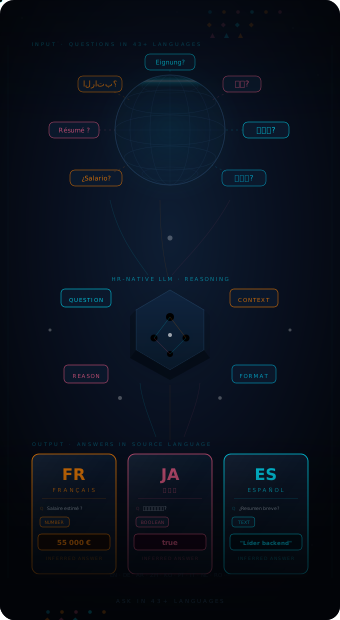
HrFlow.ai Asking is an HR-native LLM (not a generic LLM) trained on HR datasets to answer recruiting questions with the right tone, terminology, and reliability, on resumes, CVs, and job descriptions in 43+ languages. It extracts explicit data, infers implicit insights, generates HR content, and returns format-constrained outputs you can store, automate, or power RAG and agent workflows.
Built for sensitive HR data—secure by default, enterprise-ready.
TLS in transit + encryption at rest to protect documents and extracted data.
Minimal storage by default, with configurable retention policies to match your compliance needs.
Built for sensitive HR data—secure by default, enterprise-ready. AI Act– and GDPR-ready processing, with documented controls for data handling and compliance.
Data processing and storage can be aligned with your required region (e.g., EU or US) depending on your deployment.
| Feature | |   |  |  | LLMs | ||||||
|---|---|---|---|---|---|---|---|---|---|---|---|
| Deployment & Trust | |||||||||||
| Headquarters | 🇫🇷 France | 🇺🇸 USA | 🇫🇷 France | 🇨🇳 China | config | ||||||
| 🇺🇸 USA & 🇪🇺 EU Servers | Built-in | config | config | ||||||||
| GDPR / AI-Act | By design | config | config | ||||||||
| HR Compliance (Safety & Guardrails) | Built-in | ||||||||||
| Pretraining Data | HQ HR Data | Noisy & Biased Web Data | Noisy & Biased Web Data | Noisy & Biased Web Data | Noisy & Biased Web Data | ||||||
| HR-Focused | HR-tuned | ||||||||||
| Input Security (Prompt injection) | |||||||||||
| Unified output object (JSON drift) | |||||||||||
| Deterministic output values (hallucination) | |||||||||||
| Pricing model | per request (predictable) | per input+output tokens (expensive) | per input+output tokens (expensive) | per input+output token (expensive) | per hour | ||||||
| Speed (avg response / 1 page resume) | ~2s | ~4s | ~5s | ~7s | >10s | ||||||
| Speed (avg response / avg job) | ~1s | ~3s | ~4s | ~9s | >10s | ||||||
| DevOps burden (production scale) | Lowest | High | High | High | Extreme | ||||||
| Deployment model | Managed API/SaaS | Managed API | Managed API/SaaS | Managed API / SaaS / Self-host | Self-host | ||||||
| Core Technology | |||||||||||
| Multilingual | 43 lang | 40 lang | 40 lang | Unknown | Unknown | ||||||
| HR zero-config (maintenance burden) | |||||||||||
| HR Prompting | By design | ||||||||||
| Labor Market data | Built-in | config | |||||||||
| Format-constrained Output | Built-in | config | config | config | config | ||||||
| HR Stack integrations (add-ons) | |||||||||||
| Resume, CV, Job parsers | add-on (Parsing API) | Config | Config | Config | Config | ||||||
| HR data enrichment & taxonomies | Built-in (Linking/Tagging APIs) | ||||||||||
| RAG & Agentic Pipelines | add-on (Embedding API & Scoring API) | ||||||||||
| Search Engine Add-on | add-on (Searching API) | ||||||||||
| Recommender System Add-on | add-on (Scoring API) | ||||||||||
| Jobboards / ATS / HCM / HRIS connectors | 200+ connectors (Data Studio) | ||||||||||
| Candidate & Recruiter UI | Widgets (App Studio) | ||||||||||
Everything you need to know about the Asking API
Our APIs are designed to complement each other and unlock your data's full potential
Transform HR documents into structured, enriched Talent & Workforce Data — powering every layer of Hiring Intelligence.
API OverviewUnlock Hiring Superintelligence at scale — with transparent, fair, and explainable ranking across every Talent signal.
API Overview
GET STARTED
Start parsing resumes and job postings in minutes with our powerful API.
HrFlow.ai is building safe Hiring SuperIntelligence to help reduce unemployment at global scale. Founded in 2016, we are an API-first AI company building foundation models and agents for the labor market, trained on hundreds of millions of career paths and more than 1.2 billion hiring decisions. With over 100M profiles processed, we believe this capability shouldn't be locked inside a single product. Like critical infrastructure, it belongs to the entire HR ecosystem, and today over 1,000 customers build on our platform, backed by more than $10M from investors including BPI France, Amazon, Google, Microsoft, 115k, and Emerging Venture. We build AI for HR that is high-performing, explainable, and deployable at scale, designed to meet global AI compliance standards from GDPR to the EU AI Act and beyond.
The platform provides a complete and fully integrated suite of HR data processing products based on the analysis of hundreds of millions of career paths worldwide -- such as Parsing API, Tagging API, Embedding API, Searching API, Scoring API, and Upskilling API. It also offers a catalog of +200 connectors to build custom scenarios that can automate any business logic.